Fact sheet
Mount Givens Granodiorite is a biotite-hornblende granodiorite collected from the western margin of the ca. 2000 km2 Mount Givens pluton. The sample prefix indicates it was acquired during mapping of the Black Cap (BC) Mountain 15’ geologic quadrangle by Paul Bateman and assistants between 1959 and 1962. The lower case “c” denotes its position in southwestern 7.5’ quadrangle (Courtright Reservoir) of the 15’ quadrangle.
BCc-12 was collected from the quarry that was used by Pacific Gas and Electric to build the 96 m tall rock fill terminal dam of the Courtright Reservoir in 1958. The sample was one of seventeen samples selected for Kistler and colleagues 1965 K-Ar study of biotite and hornblende age distributions across the Sierra Nevada. That same year, Hurley et al. (1965) made the first measurements of initial 87Sr/86Sr on whole rocks on this sample and 28 others. Conspicuous chlorite after biotite alteration is consistent with the sample being positioned close to the Courtright shear zone. Dodge (1973) chose this sample as one of twelve used in a systematic study of secondary chlorite in plutons across the Sierra.
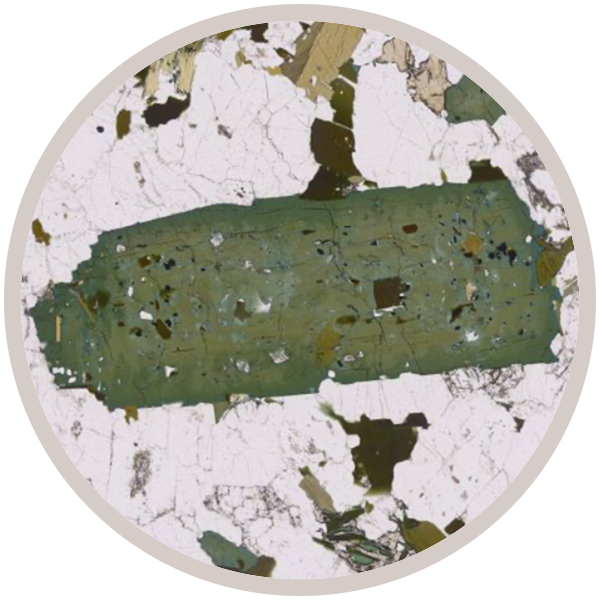
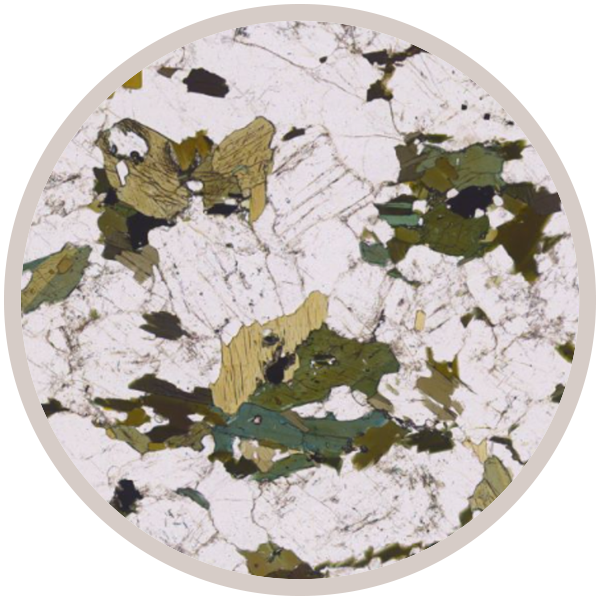
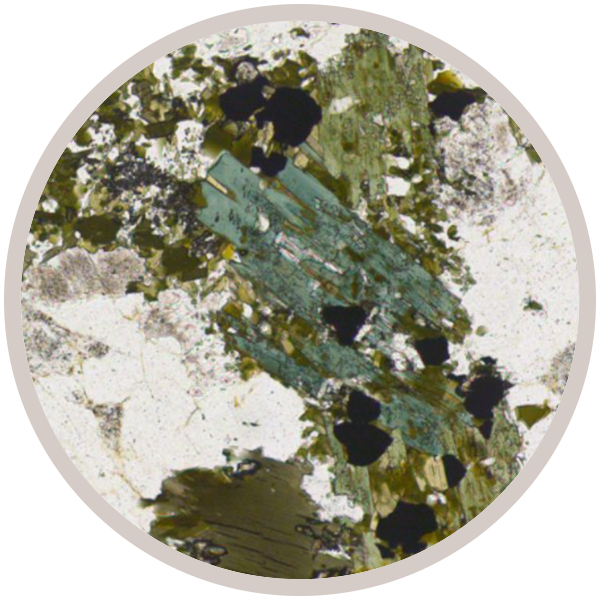
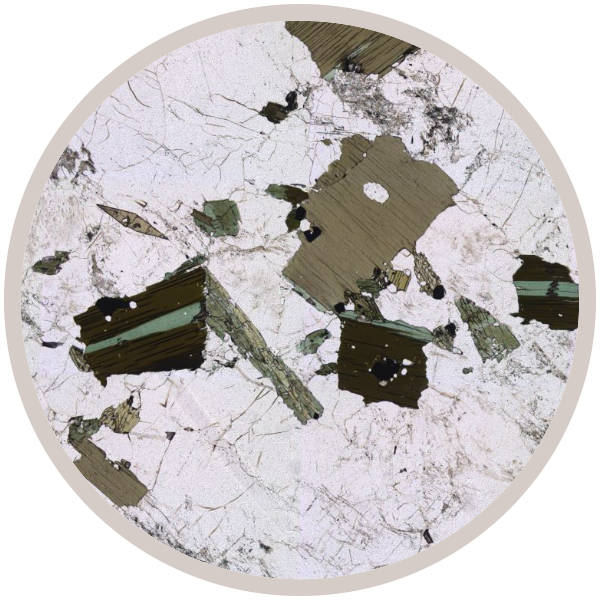
View 1 features a cluster of pleochroic brown biotite crystals intergrown with green hornblende grains. Chlorite occurs as thin strips of alteration within biotite parallel to the prominent cleavage. An irregular grain of high-relief titanite is located in the upper right quadrant. Low-relief quartz and plagioclase surround the cluster. The plagioclase feldspar shows lamellar and simple twinning as well as some oscillatory zoning.
View 2 is dominated by a large plagioclase feldspar grain with lamellar twinning and oscillatory zoning. Small grains of biotite and hornblende are also visible; one biotite grain has a broad band of pale green chlorite alteration.
References
- Hurley, P. M., Bateman, P. C., Fairbairn, H. W., and Pinson, W. H., Jr., 1965, Investigation of initial Sr87/Sr86 ratios in the Sierra Nevada plutonic province: Geological Society of America Bulletin, v. 76, no. 2, p. 165-174.
- Kistler, R. W., Bateman, P. C., and Brannock, W. W., 1965, Isotopic ages of minerals from granitic rocks of the central Sierra Nevada and Inyo Mountains, California: Geological Society of America Bulletin, v. 76, no. 2, p. 155-164.
- Dodge, F. C. W., 1973, Chlorites from granitic rocks of the central Sierra Nevada Batholith, California: Mineralogical Magazine and Journal of the Mineralogical Society, v. 39, no. 301, p. 58-64.
This collection features legacy samples from some of the earliest eras of geologic mapping of Sierra Nevada batholith, California, by United States Geological Survey mappers including Paul C. Bateman, James G. Moore, Donald C. Ross and Franklin C.W. Dodge.
These samples, among others assembled over 30 years, formed a reference collection of compositions, textures and ages of rock units across the batholith.
This Collection is the result of a partnership between the Virtual Microscope and a trio of researchers from the United States: Jade Star Lackey (Pomona College), Emily Cooperdock (Brown University), Jaime Barnes (University of Texas, Austin), who are supported in this endeavour by United States National Science Foundation Grants EAR-2211241, -42, and -43.