Fact sheet
The Granite of Dinkey Lakes
K-feldspar porphyritic, biotite granite. Paul Bateman collected this sample during geological mapping of the Huntington Lake Quadrangle (Bateman and Wones, 1972)—hence the “HL” prefix. It would later be incorporated into the Sierra Nevada reference collection under the custody of Franklin W.C. Dodge. As recorded in field notes, Bateman collected HL-29 as a “large sample” during 1960 field season from “Cliffs north of Mystery Lake Trail” in the Sierra National Forest, south of Yosemite National Park. The sample was for years considered to be part of a series of small, scattered plutons of the Quartz Monzonite of Dinkey Dome (Bateman 1992), however the type pluton of the Dinkey Dome lithodeme, a garnet-muscovite peraluminous granite, is 118 million years old (Quintero et al., 2021) and HL-29 has a U-Pb zircon age that is considerably younger (94.6±0.9 million years old, Lackey, unpublished). HL-29 appears in the first round of samples dated by the K-Ar and Rb-Sr method in the Sierra (Bateman et al. 1965). It was part of the suite of samples used in the first systematic studies of compositions of feldspars (Piwinskii, 1968) and biotite (Dodge et al. 1969) in the Sierra. It was one of the samples in Naeser and Dodge’s (1970) early study of fission track thermochronology of accessory minerals and would be studied through the early 1980s (Dodge et al. 1982).
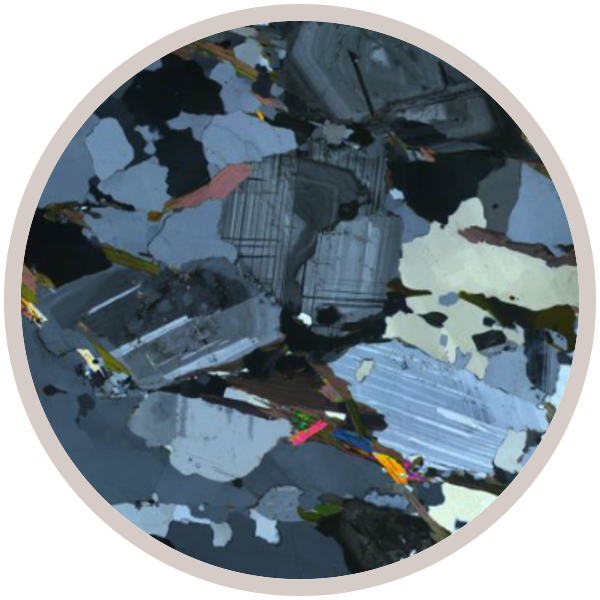
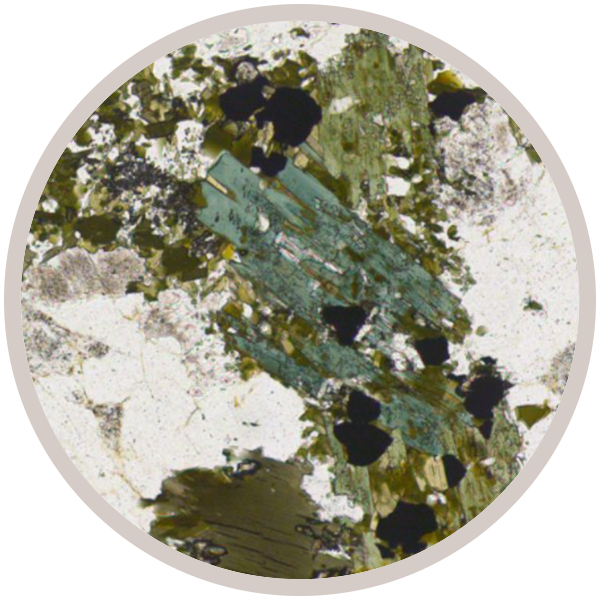
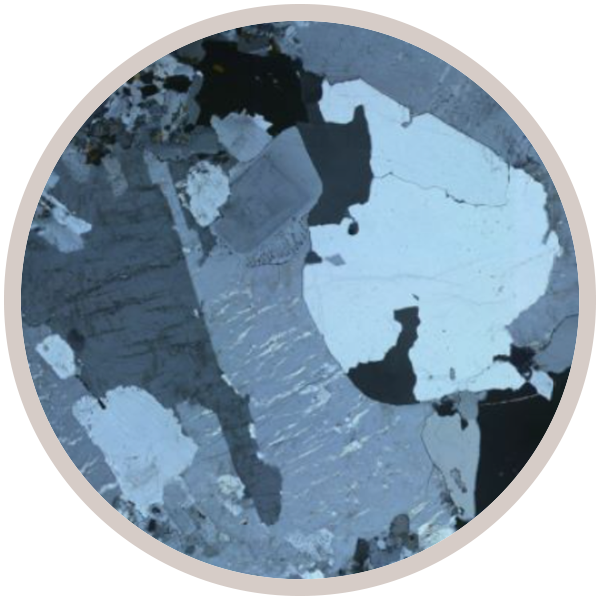
View 1 has a large, tabular K-feldspar with a bold simple twin and delicate flame perthite textures. Next to the crosshairs is a crescent-shaped lobe of myrmekite between a plagioclase feldspar with faint oscillatory zoning and the large K-feldspar crystal.
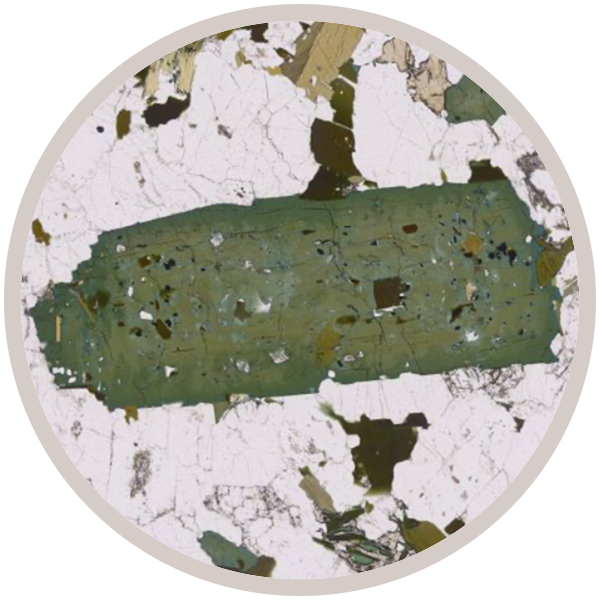
View 2 is filled with several quartz grains with interference colours in various shades of grey, indicating that they have a variety of orientations. Although most of the quartz grains have uniform extinction, suggesting they are undeformed, one or two show hints of patchy extinction indicating they are weakly strained.
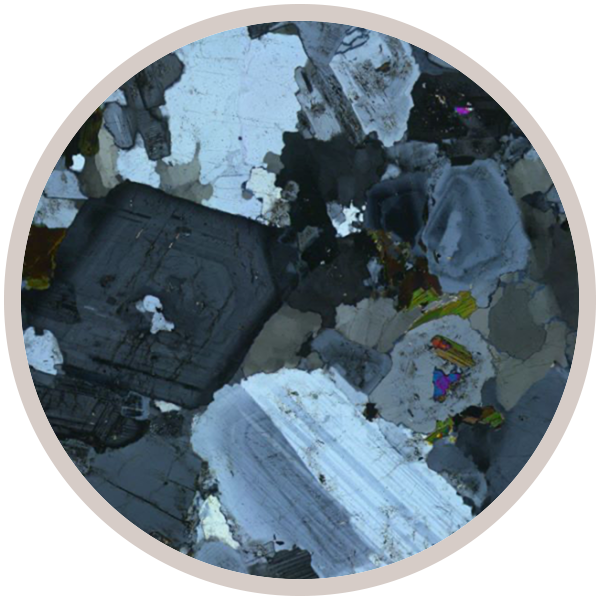
View 3 includes some K-feldspar grains with prominent flame perthite textures. Grain boundaries of these crystals are festooned with linear arrays of finer grained aggregates of quartz, plagioclase and myrmekite.
References
Bateman, P.C., 1992, Plutonism in the central part of the Sierra Nevada Batholith, California: U. S. Geological Survey Professional Paper 1483, 182 pp.
Bateman, P.C., and Wones, D.R., 1972, Geologic map of the Huntington Lake Quadrangle, central Sierra Nevada, California: U. S. Geological Survey, Geological Quadrangle GQ-0987, 1:62,500.
Dodge, F. C. W., Smith, V. C., and Mays, R. E., 1969, Biotites from granitic rocks of the central Sierra Nevada Batholith, California: Journal of Petrology, v. 10, no. 2, p. 250-271.
Dodge, F.C.W., Millard, H.T., Jr., and Elsheimer, H.N., 1982, Compositional variations and abundances of selected elements in granitoid rocks and constituent minerals, central Sierra Nevada Batholith, California: U. S. Geological Survey Professional Paper, v. 1248, p. p 24.
Kistler, R. W., Bateman, P. C., and Brannock, W. W., 1965, Isotopic ages of minerals from granitic rocks of the central Sierra Nevada and Inyo Mountains, California: Geological Society of America Bulletin, v. 76, no. 2, p. 155-164.
Piwinskii, A. J., 1968, Studies of batholithic feldspars; Sierra Nevada, California: Contributions to Mineralogy and Petrology, v. 17, no. 3, p. 204-223.
This collection features legacy samples from some of the earliest eras of geologic mapping of Sierra Nevada batholith, California, by United States Geological Survey mappers including Paul C. Bateman, James G. Moore, Donald C. Ross and Franklin C.W. Dodge.
These samples, among others assembled over 30 years, formed a reference collection of compositions, textures and ages of rock units across the batholith.
This Collection is the result of a partnership between the Virtual Microscope and a trio of researchers from the United States: Jade Star Lackey (Pomona College), Emily Cooperdock (Brown University), Jaime Barnes (University of Texas, Austin), who are supported in this endeavour by United States National Science Foundation Grants EAR-2211241, -42, and -43.