Fact sheet
Dinkey Creek Granodiorite is a hornblende-biotite granodiorite that Paul Bateman describes collecting in his field notes “from near Crabtree’s Pack Station,” in the Central Sierra Nevada, likely on a prominent road cut and turn in the Blackrock road that used to connect Coolidge Meadow to Dinkey Creek before construction of the Wishon Reservoir. Bateman (1992) notes of the Dinkey Creek’s most iconic look that it is “strongly foliated and contains a greater density of mafic clots and inclusions than any other large body of rock within the [Mariposa Quadrangle]” BCc-13 is from the southwestern (“c”) quarter-quadrangle of the Black Cap (“BC”) Mountain 15’ geologic quadrangle that Bateman and assistants mapped between 1959 and 1962. Notable among the studies in which BCc-13 has been used are the first batholith-scale studies of hornblende (1968) and biotite (1969) by Dodge and others, both of which appeared in the Journal of Petrology.
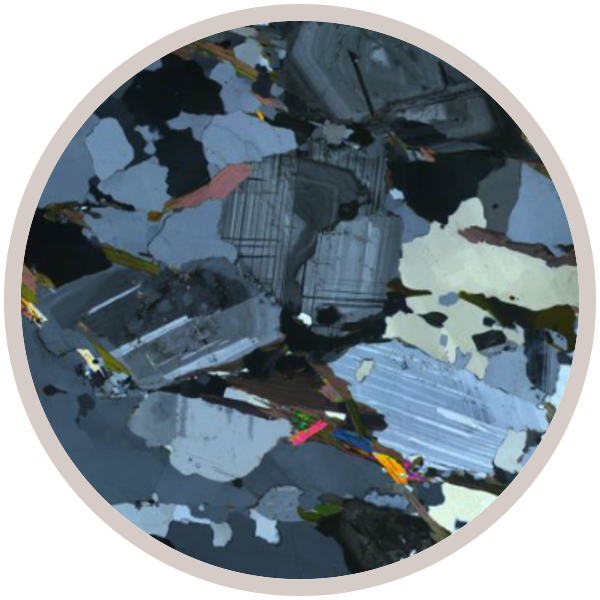
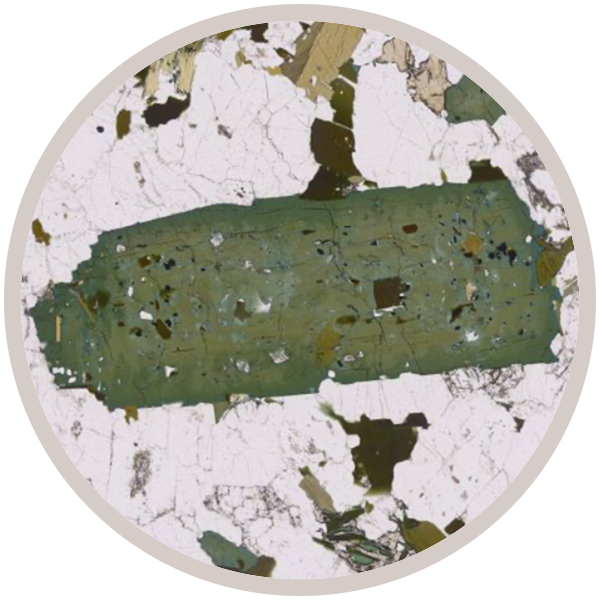
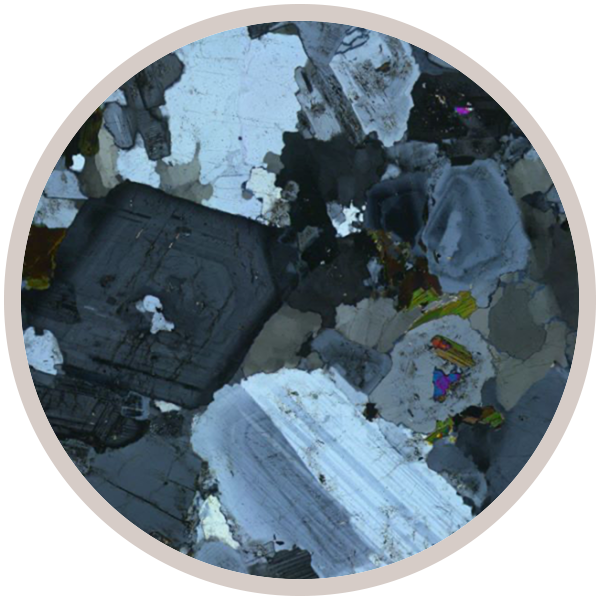
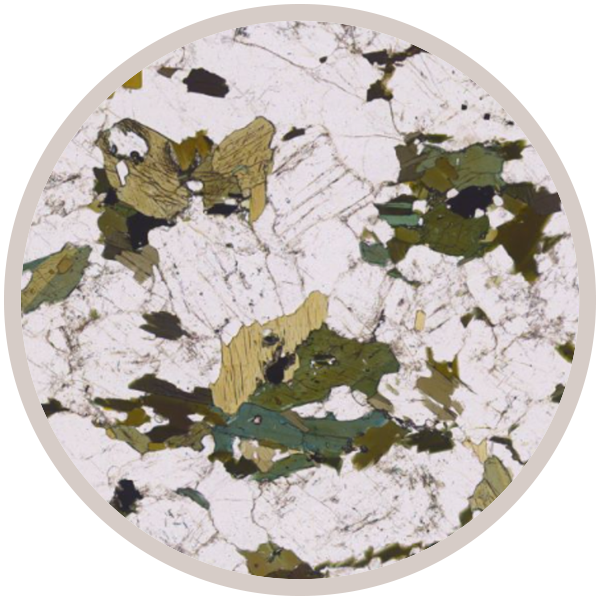
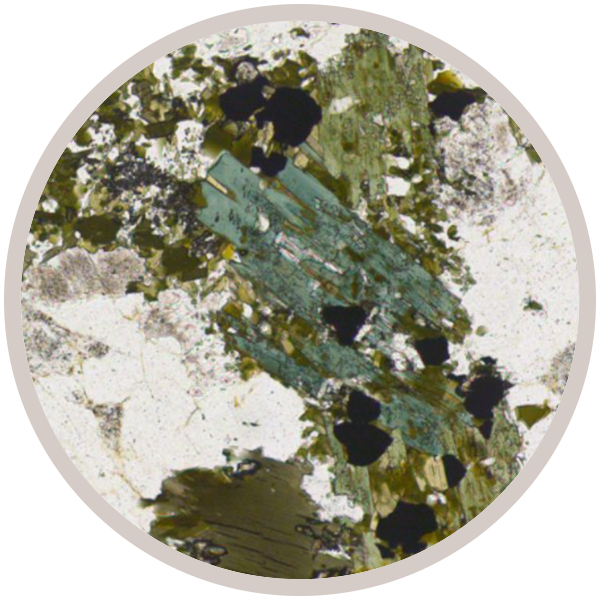
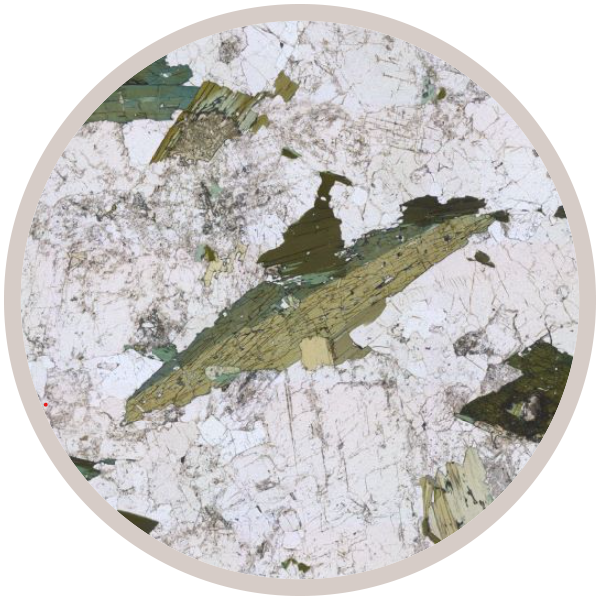
This thin section is dominated by strongly pleochroic hornblende crystals, many of which have beautiful euhedral crystal shapes, simple twins or lamellar twins.
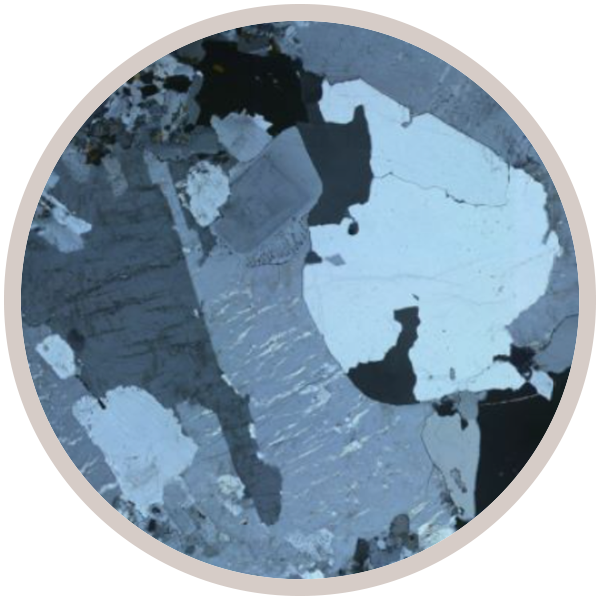
View 1 is centred on a cluster of pleochroic hornblende and biotite grains, with opaque inclusions. A titanite crystal can be seen in the upper right quadrant. Quartz and plagioclase, the latter with lamellar twinning, occupy the edge of the view. A small zircon grain with bright pink interference colours under crossed polars is in the middle of the lower left quadrant. Another is visible in a large biotite crystal in the upper right quadrant, with a narrow pleochroic halo.
View 2 features a lamellar-twinned plagioclase grain with oscillatory zoning, along with biotite and hornblende crystals. Some of the hornblendes have single, lamellar twins; two other grains show euhedral shape and typical intersecting cleavage sets.
References
- Dodge, F. C. W., and Moore, J. G., 1968, Occurrence and composition of biotites from the Cartridge Pass Pluton of the Sierra Nevada Batholith, California: U. S. Geological Survey Professional Paper, p. B6-B10.
- Dodge, F. C. W., Papike, J. J., and Mays, R. E., 1968, Hornblendes from granitic rocks of the central Sierra Nevada Batholith, California: Journal of Petrology, v. 9, no. 3, p. 378-410.
- Dodge, F. C. W., Smith, V. C., and Mays, R. E., 1969, Biotites from granitic rocks of the central Sierra Nevada Batholith, California: Journal of Petrology, v. 10, no. 2, p. 250-271.
- Bateman, P. C., 1992, Plutonism in the central part of the Sierra Nevada Batholith, California: U. S. Geological Survey Professional Paper 1483, 182 pp.
This collection features legacy samples from some of the earliest eras of geologic mapping of Sierra Nevada batholith, California, by United States Geological Survey mappers including Paul C. Bateman, James G. Moore, Donald C. Ross and Franklin C.W. Dodge.
These samples, among others assembled over 30 years, formed a reference collection of compositions, textures and ages of rock units across the batholith.
This Collection is the result of a partnership between the Virtual Microscope and a trio of researchers from the United States: Jade Star Lackey (Pomona College), Emily Cooperdock (Brown University), Jaime Barnes (University of Texas, Austin), who are supported in this endeavour by United States National Science Foundation Grants EAR-2211241, -42, and -43.